


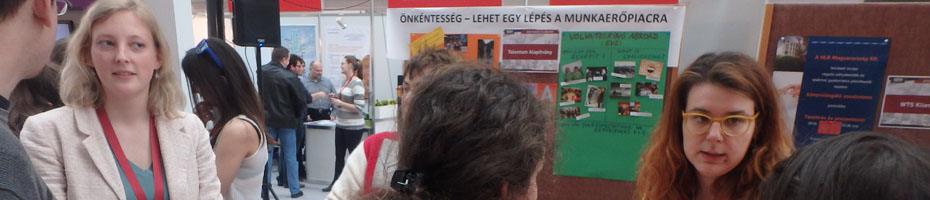












VOLWEM project – Volunteering for employment
Country:
SK
Subject:
Working with disadvantaged target group
Start and end date:
2012, October 1 to 2014, September 30
Intervention level, geographic area:
international
Objectives of the project/program:
VOLWEM Project wanted to contribute to the creation of the following conditions in Slovakia:
- job centres (labour offices) are aware and accept volunteer opportunities as a way to gain experience and motivate unemployed people for such activity;
- volunteer centres educate organizations involving volunteers in specifics of work with unemployed volunteers and NGOs are actively cooperating with unemployed volunteers;
- institutions of formal education are aware about opportunities and existing systems of recognition of non-formal education gained through volunteering;
- employers are aware about benefits of volunteering and consider the information on active engagement in volunteering of a job seeker as important.
Description of project/program:
There were four volunteer centres involved into the VOLWEM Project (in Banska Bystrica, Košice, Nitra, and Prešov). Their role was to involve at least 15 unemployed people into volunteering. This part of the project was used for the validation of methodologies and tools produced within the partnership and consider it to be the most important source of inspiration and experience. Volunteer centres were key players for the work with unemployed volunteers. They were cooperating with all stakeholders: with unemployed volunteers, organizations involving volunteers, labour offices (job centres), and the university.
During the project run, the involved volunteer centres (with the help of organizations working with volunteers) were working with more than 150 unemployed people, 96 of which were actually involved into volunteering activities. Thirty-three of these volunteers (34.38 %) were able to get a job during or after their participation in the project.
Volunteers were helping in 28 non-profit nongovernmental organizations active in various fields, e.g. at mothers´ centre, community centre, organizations providing social services, children and youth organizations, but also in cultural organizations such as a museum or a university library. Unemployed volunteers were involved into many activities – they provided help with administration, technical assistance, leisure time activities with children but also with seniors, disabled people, but also helped to drug-addicts. They have organized leisure time courses, creative workshops, participated in the creation of campaigns and projects, helped with the renovation of interior but also exterior of organizations, participated in the public money collections, were approaching sponsors and donors, helped children with homework, and participated in many other activities for the benefit of the organizations they were active in.
Based on the analysis of competence questionnaires and online tool D-zručnosti pre zamestnanie we can state that volunteering created for unemployed people a space for the development of specific skills, knowledge, and attitudes and thus contributed to the development of their employability.
Overall evaluation of the development of individual groups of competences documented through the questionnaires points out to the fact that volunteering activities created space especially for the development of competences related to problem solving and communication competences.
Existing empirical findings and specific practical experience in the area of work with unemployed volunteers proves that volunteering can be one of the tools for the support of employability and employment of these people. To reach such a situation we need two conditions: on one hand the development of specific programs focused on the involvement of unemployed people into volunteering that are based on their real needs and on the other hand the improvement in the area of recognition of the volunteering experience on the labour market.
Outcomes:
- Methodology for volunteer centres and organizations involving volunteers on how to engage unemployed volunteers called Try It Another Way.
- How to Work with Unemployed Volunteers – Training for Volunteer Centers and Organizations Involving Volunteers
- D-zručnosti pre zamestnanie – Online Tool for Recognition of Skills Acquired through Volunteering. D-zručnosti pre zamestnanie can be found in Slovak language at http://dzrucnosti.dobrovolnickecentra.sk.
- Benefits of Volunteering for Unemployed People – VOLWEM Project
- Research with employers.
all outcomes and publications are available at (also in English version) : http://volwem.dobrovolnickecentra.sk.
Financial sources:
European Commission within the Life-long Learning program – Leonardo da Vinci – transfer of innovations.
References:
Organiser(s):
Consortium of partners:
Matej Bel University in Banská Bystrica
Národná 12, 974 01 Banská Bystrica, Slovakia
Tel: +421/48/4464 1111, +421/48/4153 3180
E-mail: alzbeta.gregorova@umb.sk